The Irgun Tzvei Leumi B’Eretz Yisrael (known by the acronym, Etzel) or National Military Organization in the Land of Israel, was born out of the Revisionist Movement, led by Ze’ev Jabotinsky. In the spring of 1920, following the Conference at San Remo in 1920, it was determined that the Balfour Declaration would be binding, and thus, the first Arab riots ensued.
In Jerusalem, The Jewish Council of Delegates anticipated the violence and placed Jabotinsky in charge of subduing the coming riots. There was great confidence in Jabotinsky due to his experience fighting the Turks in WWI; he was one of the founders of the Jewish Battalions of the British Army. That unit conquered Palestine from the Ottomans. In charge of establishing a defense force, Jabotinsky founded the Haganah, without which a great many more Jews would have died in the riots of 1920.
Once the violence quelled, the British arrested both the Arab aggressors and the Jewish defenders, including Jabotinsky and several other Haganah members. Jabotinsky, who was given a harsh sentence that included expulsion from Palestine, was disgusted that he was treated in a similar fashion to the Arab aggressors. Eventually, he was released and all charges were dropped against both Arabs and Jews.
In 1925, Jabotinsky founded the Revisionist movement as a result of an ideological split with the Haganah. While the Haganah promoted a socialist agenda, Jabotinsky sought to create a free-enterprise Jewish country, post-liberation. Yet there was another pivotal difference – the Haganah was an entity which promoted havlaga, or restraint, as opposed to retaliation. If it weren’t for the militant efforts of the Irgun and Lehi, Israel would have been under British occupation far longer.
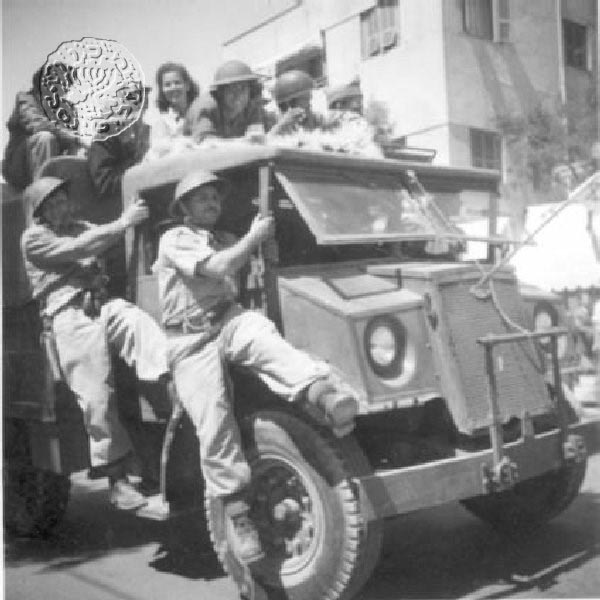
Etzel fighters riding through the streets of Tel Aviv after a victorious show in Jaffa; 1948
In 1931, the Irgun was founded by a band of commanders from Haganah who disagreed with the organization’s line of defense, and whose main aim was armed struggle against the Arabs. The newly formed group felt that the Haganah was too weak when faced with both the British rule and Arab oppression. Avraham Stern, who later founded Lehi, was among this influential faction. Ben-Gurion, on the other hand, viewed the Irgun as a “harmful, destructive gang” and thought them (as well as the Lehi) to be a threat to diplomatic efforts.
The Irgun readily pursued a tactic of armed resistance, resulting in one of its members being hanged by the British for shooting at an Arab bus. During the Arab rights of 1936-1937, the members were divided along ideological lines. Many returned to the Haganah, and of those who remained, elected Jabotinsky as their leader.
Portrait of Ze'ev Jabotinsky Founder of Betar and Irgun (Etzel)
It is not lost on history that just as WWII was set to erupt and the Jewish people faced extermination in Europe, Britain issued yet another antisemitic immigration restriction. After the White Paper of 1939 was declared, the Irgun rapidly escalated attacks on the British. However, in 1939, with the onset of WWII, a ceasefire was agreed upon. Avraham Stern rebuked this decision and formed his own more militant group, Lehi. After Jabotinsky’s death, Menachem Begin assumed leadership and in 1944 the group declared war against the British. They were responsible (along with the Lehi) for blowing up bridges and railway stations to rid Palestine of the British occupiers. Menachem Begin would later become one of Israel’s esteemed Prime Ministers.
The Sergeant's Affair - What Actually Drove the British Occupiers Out of Palestine:
While the British were fighting the Nazis, their antisemitic policies against Jews in Palestine intensified: not only was immigration of Diaspora Jews severely limited, but now Jews were also unable to purchase land in their own homeland.
However, all the military campaigns of the Irgun and Lehi were curtailed as its members joined the British to aid in the fight against the Nazis. Many ended up in North Africa and in Italy. It was the Lehi, Irgun, along with the Betar members who helped organize the Warsaw Ghetto uprising.
After four years of war, and millions of murdered Jews, the Irgun under leadership of Menachem Begin deemed correctly that the British were striving “for the destruction of our people’s last hope,” and declared that the ceasefire was over and increased their attacks against the British occupiers.
In response, detention camps across Africa were filled with Irgun and Lehi members. The liberal Kappo Jewish Agency, fearing to lose the fake support of the British, launched surveillance, kidnappings and investigations of suspected Lehi or Irgun members and turned them in to the British occupiers or otherwise snitched on their whereabouts.
Wanted poster for Irgun & Lehi members. Menachem Begin is featured on the top left.
It was not until the end of WWII that the various resistance groups began to work together after the liberal ones realized the White Papers were not going to be dissolved and more Jews were being detained. The 1947 Partition Plan at the UN is a misnomer — in actuality, it was a British-led coup against Israel to steal even more land from the paltry 22% of land left of the Judean homeland. That was the final straw for the resistance groups.
In April 1947, one of the Irgun’s largest operations took place, the Acre Prison break which allowed 41 members of the underground movements, along with others, including 214 Arab occupiers, to escape. When three of the members, Avshalom Haviv, Meir Nakar, and Yaakov Weisswho carried out the operation were caught and sentenced to death, the Irgun retaliated by kidnapping two British sergeants. In less than 24 hours after the three Irgun members were executed, the British hostages were found dead, hanging from trees and booby-trapped with explosives outside of Netanya.
The Sergeant’s Affair is what propelled the British occupiers to leave Israel. The British ‘Mandate’ aka occupation (the actual Mandate – legal promise – barely lasted two years) did not end on the occupiers’ terms – the indigenous Judeans liberated what was left of the Judean homeland from the antisemitic clutches of the British occupiers through justified violent means.